
Broken Torsion Springs
They lead the list, especially on doors original to houses from the 1960s and 70s. Those springs weren't built to last the life of the house, and once they go the door won't lift at all or someone gets hurt trying to force it.
Cedar Rapids, IA
Trusted garage door repair for Cedar Rapids homes, covering springs, openers, panels, and honest replacement advice from your local repair team.
Garage door services


Common Cedar Rapids garage door problems
Broken torsion springs lead the list, especially on doors original to houses from the 1960s and 70s stretch of the housing stock - those springs weren't built to last the life of the house, and once they go the door won't lift at all or someone gets hurt trying to force it. After that it's cable fraying, rollers worn to the point the door binds in the track, and openers that have simply reached the end of their run. Cedar Rapids sits in a cold-moderate climate band, and winter temperature swings put extra strain on metal springs and plastic opener gears already near the end of their service life - cold makes a marginal part fail instead of limping along another season. We also get a steady run of calls where the door looks fine but the opener's drive gear has stripped, which sounds like a spring problem on the phone but isn't, which is part of why we ask questions before we guess at parts.
They lead the list, especially on doors original to houses from the 1960s and 70s. Those springs weren't built to last the life of the house, and once they go the door won't lift at all or someone gets hurt trying to force it.
Lift cables fray with age and use, a steady second behind spring failures across the housing stock here, from the older sections near downtown to the newer construction further out.
Rollers wear down to the point the door binds in the track, dragging and running rough until they're swapped out.
Openers that have simply reached the end of their run, with winter temperature swings straining plastic gears already near the end of their service life.
Sometimes the door looks fine but the opener's drive gear has stripped - it sounds like a spring problem on the phone but isn't, which is why we ask questions before guessing at parts.
Clear repair guidance
We don't quote a number until we know what's actually wrong, because the job depends on what's behind the panel. A broken torsion spring on a 1970s double-car door is a different job than a bent track on a newer build off one of the areas further out toward Robins or Swisher. Door width, spring type, and whether the opener is original to the house all change the math.
What we can tell you is what moves the price: single spring versus a two-spring set on a double door, steel rollers versus nylon, and whether the track needs realigning or full replacement. Houses built before the mid-1980s often have hardware that doesn't match what's on the shelf today, which can mean a slightly longer job to source the right torsion tube or drum.
We don't pad a quote with work you don't need. If a cable is frayed but the drum and spring are fine, we replace the cable and leave the rest alone. That's the honest version of pricing: not a flat number, but a clear answer on the phone before the truck shows up.
Local housing matters
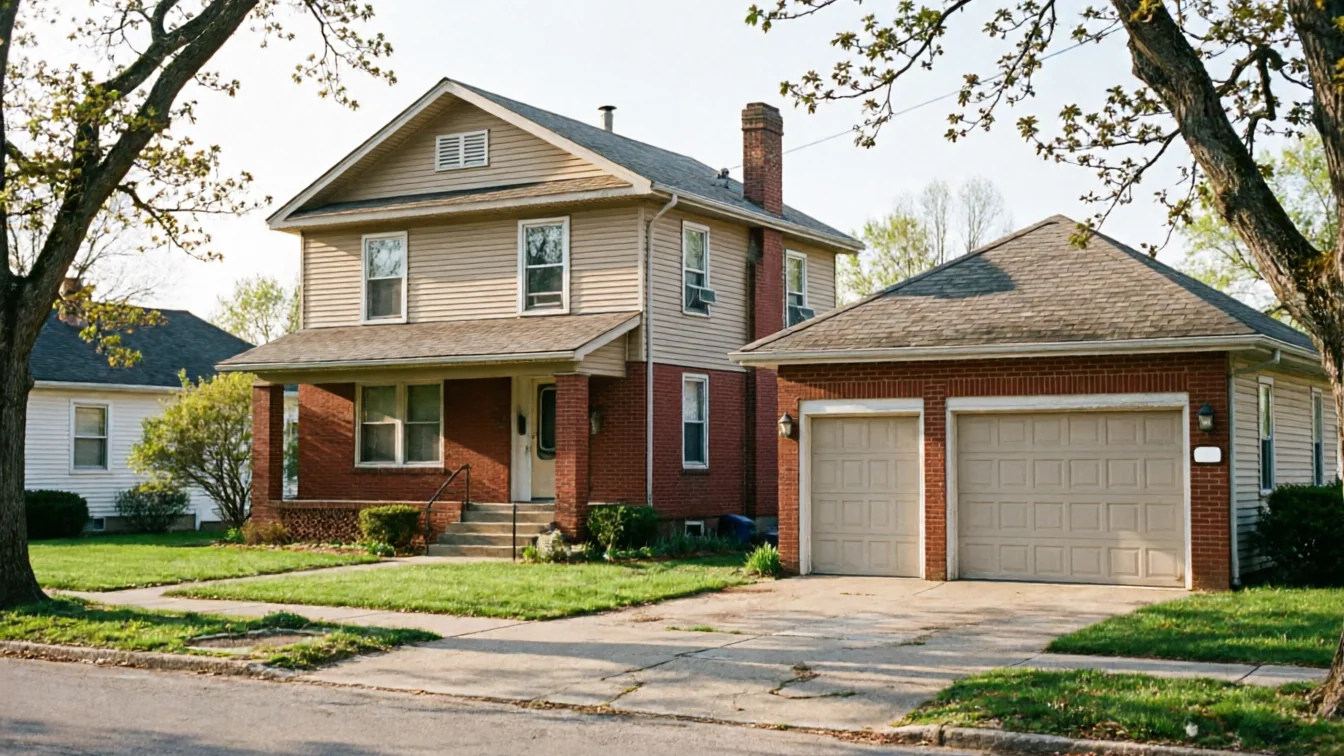
Cedar Rapids houses span a wide range - construction here runs from 1943 up through 2011, with the median sitting around 1977. That's not a small window. It means a single street can have a house built in the Eisenhower years next to one from the last decade, and the garage door hardware on each one is nothing alike.
Most of the stock, though, is concentrated in the 1960s and 70s, spread across two dozen named areas, from Southwest Area and Oakhill Jackson close in to Cedar Hills a few miles west. That era of construction tends to carry torsion springs sized for doors that are narrower and lighter than what gets installed new today, and openers that have usually been swapped out once or twice already.
With 50,436 households in the area and 23,691 owner-occupied houses, there's a lot of variety in what we see on a given week - original one-piece doors still hanging on, mid-80s retrofits, and newer insulated sectional doors on houses built in the 2000s. Knowing which decade a house likely falls into tells us a lot before we even open the garage.
1940s-2000s garage door systems
With construction running from 1943 through 2011 and the median around 1977, a given week brings a lot of variety - original one-piece doors still hanging on, mid-80s retrofits, and newer insulated sectional doors on houses built in the 2000s. Knowing which decade a house likely falls into tells us a lot before we even open the garage, and it helps us bring the right parts on the first trip.
Original one-piece doors are still hanging on at the older end of the 1943-2011 range, with narrower openings and hardware that's harder to source parts for.
Most of the stock carries torsion springs sized for doors that are narrower and lighter than what gets installed new today.
A lot of doors are mid-80s retrofits, and hardware from before the mid-1980s often doesn't match what's on the shelf now.
Houses built in the 2000s usually run newer insulated sectional doors - wider, with steel rollers and openers that carry modern safety sensors.
Openers have usually been swapped out once or twice already, so an opener original to the house is the exception rather than the rule.
What to expect
You call and describe what the door is doing; we ask a few questions, give you a time window, and head out with the parts likely to fix what you described. On site we look at the whole system, not just the symptom, and we tell you what we see and what it costs before anything gets touched.
You describe what the door is doing - won't open, opens crooked, makes a bang and stops, or the opener runs but the door doesn't move.
We ask the age of the door if you know it, whether it's one spring or two, and whether anything looked or sounded different right before it quit.
We give you a time window and head out with the parts likely to fix what you described. Torsion springs, rollers, and cable are what we carry standing by, since they're the parts that fail most often across the housing stock here.
On site we look at the whole system, not just the symptom - a broken spring sometimes comes with worn cable or a track knocked slightly out of line by the same event. We tell you what we see and what it costs before anything gets touched, and if the fix is simple we do it on the spot.
Parts We Don't Carry on the Truck
If the fix needs a part we don't have on the truck - often older hardware that doesn't match what's on the shelf today - we tell you that up front and give you a real timeline instead of a guess.
Repair or replace?
Sometimes the honest answer is that fixing it isn't worth it, and sometimes it clearly is. We'll tell you straight when a door from the older end of the 1943-2011 range has reached the point where repairs stack up close to a new door, rather than pile patchwork on an old frame - but we don't push replacement as a default. Plenty of doors built in the 1970s and 80s are structurally fine and just need the moving parts swapped. The honest version of this business means telling you when a $150 part saves the door and when it doesn't.
If an older door needs a new spring, new cable, and a new opener in the same visit, you're paying for parts and labor that add up close to a new door anyway.
A replacement comes with better insulation and a warranty on top of it, which stacking repairs on an old frame won't match.
A door painted over a cracked panel, or a track that's been bent and re-bent, doesn't owe anyone more patchwork.
Plenty of 1970s and 80s doors are structurally fine and just need the moving parts swapped - spring, rollers, maybe a cable. If the panel and track are sound, there's no reason to replace a door that still has years left in it.
Towns we serve
From our Cedar Rapids, IA base we run trucks across the surrounding towns rather than keeping a storefront in each one. Fairfax, Hiawatha, and Marion are within a few miles, and we run further out to places like Mount Vernon and Solon.
The wider service area also reaches Ely, Robins, Swisher, Shueyville, Palo, Springville, Alburnett, Shellsburg, Norway, Newhall, Amana, Lisbon, North Liberty, Center Point, Martelle, Oxford, Tiffin, Central City, and Coralville. Call and tell us where you are and we'll let you know if it's in range - pick an area below to see the local detail.
Questions
A lot of the housing stock here went up in the 1960s and 70s, which means a lot of torsion springs are the same age and were rated for a similar lifespan. When one goes in a given winter, it's common for several on the same block to follow within a season or two, since they were installed around the same time.
Some. Houses from the older end of our 1943-2011 range often have narrower doors and original hardware that's harder to source parts for. Newer builds usually have wider doors, steel rollers, and openers with modern safety sensors. It's a starting point, not a diagnosis, but it helps us bring the right parts on the first trip.
We work across the wider service area, including towns like Fairfax, Hiawatha, and Marion within a few miles, and further out to places like Mount Vernon and Solon. Call and tell us where you are and we'll let you know if it's in range.
If you're looking at replacing the spring, cable, and opener all at once, especially on an older door, the repair cost starts closing in on a new door's price. We'll walk you through both numbers on the visit so you're deciding with real figures, not a guess.
Ready when you are
Cedar Rapids Garage Door Pros repairs and installs garage doors, springs and openers in Cedar Rapids, IA and the surrounding area.